



The Plane Is Going to Crash But First We Get to See a Close-up Of a Mountain
March 4, 2026
The Sleeping Whale Pod
March 6, 2026

Addiction news
Just because it is manifestly suicidal in reality to harm one’s own body, brain or perhaps – with, say 'gambling away one’s own personal finances' – that does not mean that this is a weakness.
How does a colossal flying machine traverse the globe?
Russell Trotter Steedman
10:30 GMT Thursday, 4 March 2026
I
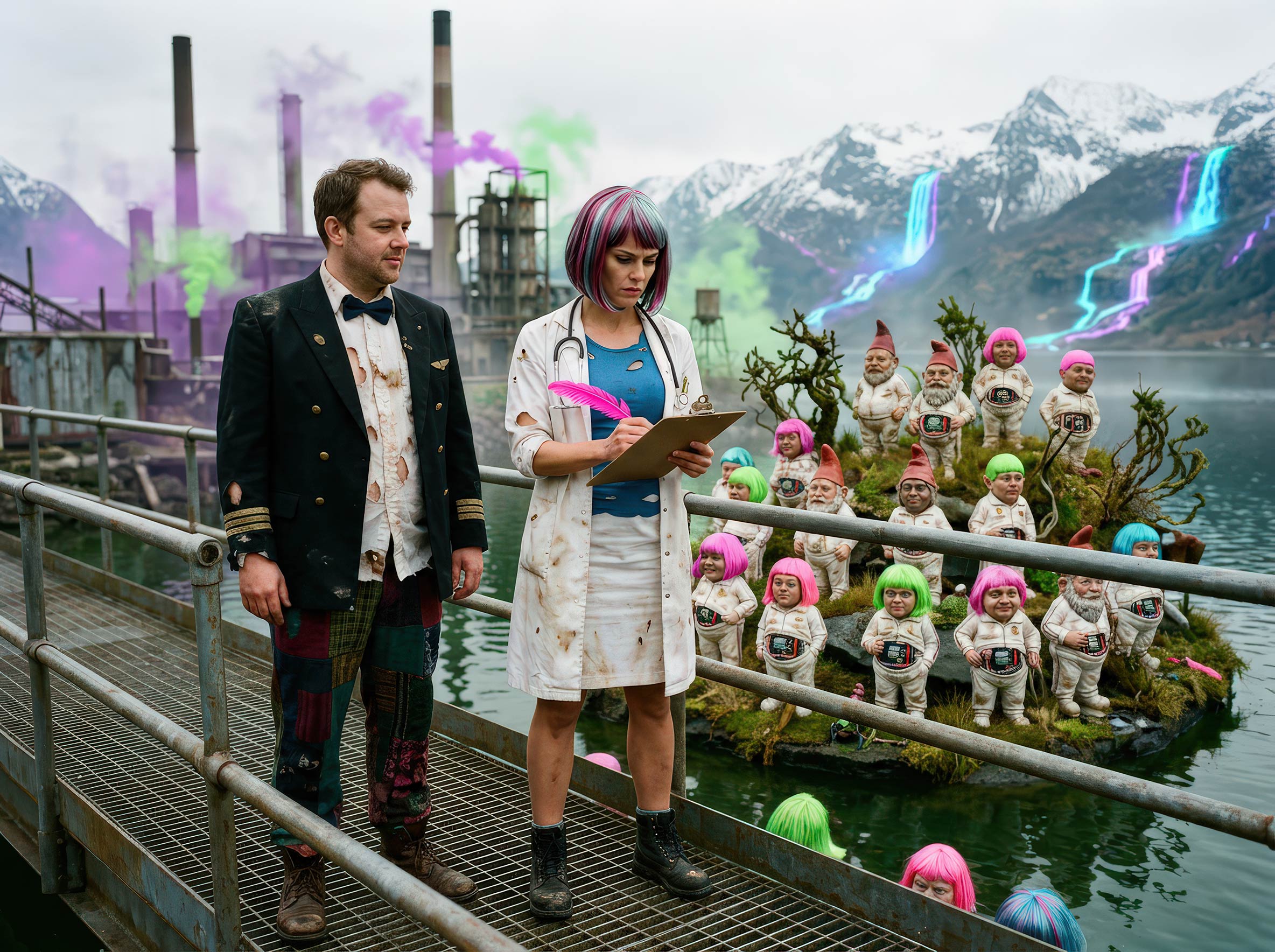
n The Monkey In The Tunnel, the first book from my Tales From The Fabrik Zone series of novels, with the primary theme of ‘addiction’, Doctor Filippa represents the ‘voice of the medical establishment’.
Unlike the other nine stories in the book Story 5: The Epic Flight of The Colossal Flying Machine, isn’t not concerned with any specific addiction itself. However, at the same time, this story is perhaps intended to show The Doctor’s commitment leave to her work. This is her own addiction.
The genesis of the story is, when journalling extensively when attempting to overcome some of my own ‘sticky troubles’ as I may refer to them, I happened upon the vision, I could possibly call it, that, in order to become truly free from the grip of a very real addiction one may be required of themselves to view the whole process as not un-akin to a gigantic flying apparatus being prepared then taking off and flying from one side of the Earth to the other.
Of course, at the very same time, when an addict does ‘recover’ the act itself is simply ‘laying down ones arms’, or in this case perhaps ‘syringes’ or ‘cans of beer’.
This is very likely a sad irony of addiction because when non-addicts view an addict as ‘weak willed’ this exact ideation may well speak to this simple reality - all we are required of ourselves is to cease the activity.
Since when did the ‘Not-action of driving to the petrol station late at night’ become so complicated and even, arguably ‘impossible?
It’s very questionable indeed whether ‘weak’ is the correct word at all.
The will to continue requires rather extreme and excessive work in itself.
Is this not a strength?
Just because it is manifestly suicidal in reality to harm one’s own body, brain or perhaps – with, say 'gambling away one’s own personal finances' – that does not mean that this is a weakness.
Once the ideation has become solidified in one’s mind that the process and activity is ‘for the good of my life’ any other course of action becomes simply, ‘Well that just can’t be’.
In The Wire, the brilliant HBO series ‘Bubs’, the ‘life-long addict’ character and his junkie sidekick spend their days searching for metal radiators and so on to sell for scrap.
Lugging heavy metal around in old shopping trolleys isn’t, on the surface to me anyway, actually weak.
It’s the polar opposite.
Yet society itself may well view a man sitting in an office twiddling his thumbs all day as ‘strong’ in comparison.
Since the whole of my life is dedicated to analysing and working out the reasons behind – or certainly ‘at the bottom’ of – why individuals, or even ‘groups’ of people come to form serious life-ending addictions and compulsive conditions, I have long sought to understand the reasons for regarding addicts as weak.
In the end the man in the office not taking drugs or behaving compulsively actually is stronger.
In terms of survival-ism at least not poisoning ourselves makes perfect sense.
The clean and sober office man is winning and succeeding at survival-ism.
However, let’s, for a minute or two, consider ‘something else’ that may be going on.
Whether the ‘stats’ show that perhaps one in twenty is addicted or not, we all, at some point do become compulsive in our very thinking processes.
Let;s assume that ‘Office Man’ as we’ll call him doesn’t touch drink or drugs at all or engage in any type of compulsive activity as such. However his wife is a ‘Proto-Alcoholic’.
She’s – becoming one.
He can’t take his mind off of the fact. He’s worried.
Now, the ‘Addicts out in the field’, well –he can literally see them out of his window.
They are certainly reckless and they are far more unhealthy in essence than Office Man.
However they are enjoying their day. They are in fact fairly relaxed.
Who is weak?
One way of looking at the comparison itself is that the more indifferent one is the stronger, potentially at least that person is, in effect.
Let’s say Office Man’s wife ends up in crisis. Meanwhile ‘Junkie Street Walking Man’s’ mother ends up in a similar crisis.
Both have fallen down stairs in their homes.
They make a call to ask for help.
If the Junkie Man’s relaxed state leads to him replying, ‘Sure, no problem. I’ll be there soon’ leads to him helping and Office Man’s almost paranoid state leads to him deliberating and failing to act decisively and fast then the entire narrative structure of who is strong and who is weak in terms of addiction can start to fall apart,
It becomes simple semantics.
Addiction and indifference are intertwined.
It could be the case even that, to some extent at least we are all addicts and all indifferent, depending on the circumstances at any particular moment in our lives.
Proper ‘strength’ may simply lie in the ‘balance in the middle’ between being stuck to a behaviour and being too loose and free from any adherence to real logic.
Is this why we award gymnasts?
A gymnast is displaying the perfect balance, or as close to it as we can ever get.
Somewhat ironically a gymnast must simultaneously be committed to a rather extreme and intensive training and also relaxed and confident enough to execute the display of all this training in a live event.
In the story, Doctor Filippa, like she does with Alma The Pilot in Story 4: The Plane is Going to Crash... is trying to ‘get to the bottom of things’ with Evan, another pilot.
Although The Doctor’s technique remains the same this pilot is a different kettle of fish.
Her strategy of getting to the bottom of him ‘stays’ yet her tactics this time differ.
This time The Doctor has decided to ‘put her own life on the line’ and fly with Evan to check out his competence.
In the analogy itself my reasoning behind the title of The Epic Flight of The Colossal Flying Machine lies in the overall difficulty of deciphering, utilising and then managing the ‘true articles’ of sobriety maintenance once an addict has crossed over the line from compulsion into active addiction and rendered themselves once again free from the substance or behaviour itself.
Since the statistics show that, in general ninety percent of addicts eventually relapse, this is a quite startling statistic to consider.
In any ways it sounds like a practical guarantee that, once an addict, you actually will relapse at some stage. It seems inevitable.
I find it is helpful to not dismiss the logic in the statistics at this point.
Of course we could simply say this seems unreasonable. After all we are ‘built to survive’. Why would we, once we’ve gotten ‘all cleaned up’ and been motivated to do so, simply lapse back into our previous states?
It doesn’t really seem to make sense.
Is it because ongoing sobriety requires a holistic, fully-engaged commitment though for the rest of our natural lives?
To me this could well be the case.
The analogy of the flying machine taking off and gliding majestically across the skies from Europe to Australia is based around the principle that the flight itself may comprise one percent of the effort and organisation of this flight successfully taking off and landing at its destination.
Another way of interpreting the same style of analogy may be watching a film.
The film itself is the outcome of a considerable amount of work.
The flying machine, at the outset, must be designed of course.
Each part is as significant as any other part.
Nothing can be simply ‘glossed over’.
Certainly in many other areas of life perfectionism isn’t a tool for growth. It can and does stifle creativity. After all a painter of pictures who achieves an output of three-hundred and sixty-five paintings in a year is far more likely to produce a masterpiece than the painter who concentrates on one ‘perfect paining’ each year.
Think about it - Vincent Van Gogh threw most of his ‘attempts’ in the scrap.
An aeroplane doesn’t’ work this way.
It can’t.
Human judgement is inherent in the entire system governing commercial flight.
It is said that air traffic control may be one of the safest industries from the threat of AI.
After all are we really going to trust machines themselves to guide our planes through the sky and land then for us?
It’s not unthinkable and it likely will become the case in the long-run but, for now we are far more likely to trust a machine to say, paint a picture for us.
After all who will come to harm if the painting goes wrong?
So, in the story every single piece of how and why a large jet-plane can and does come to depart and then arrive at its final destination becomes a metaphor for how we can be in the ten percent of ‘success stories’ when it comes to lasting sobriety.
Uncovering the reasons behind, or indeed ‘at the very bottom’ of why we act upon impulses and triggers may in fact be necessary to identify the reasons behind our behaviour and change ourselves to direct our inevitable energy differently.
So, when it comes to contemplating sobriety the feeling I have is to not be overwhelmed by this ‘load’ or ‘weight’ but to embrace it and accept that we are on a journey forever.
The journey to the promised land which, in many ways, actually is simply returning to our prior non-addicted state.

Russell Trotter Steedman
Latest posts by Russell Trotter Steedman (see all)
- The Monkey In The Next Tunnel - March 12, 2026
- The Broken Jigsaw - March 12, 2026
- The Residue Of Shame - March 12, 2026