


The Man Who Swam Out The Harbour
March 3, 2026
The Epic Flight of The Colossal Flying Machine
March 6, 2026

Addiction news
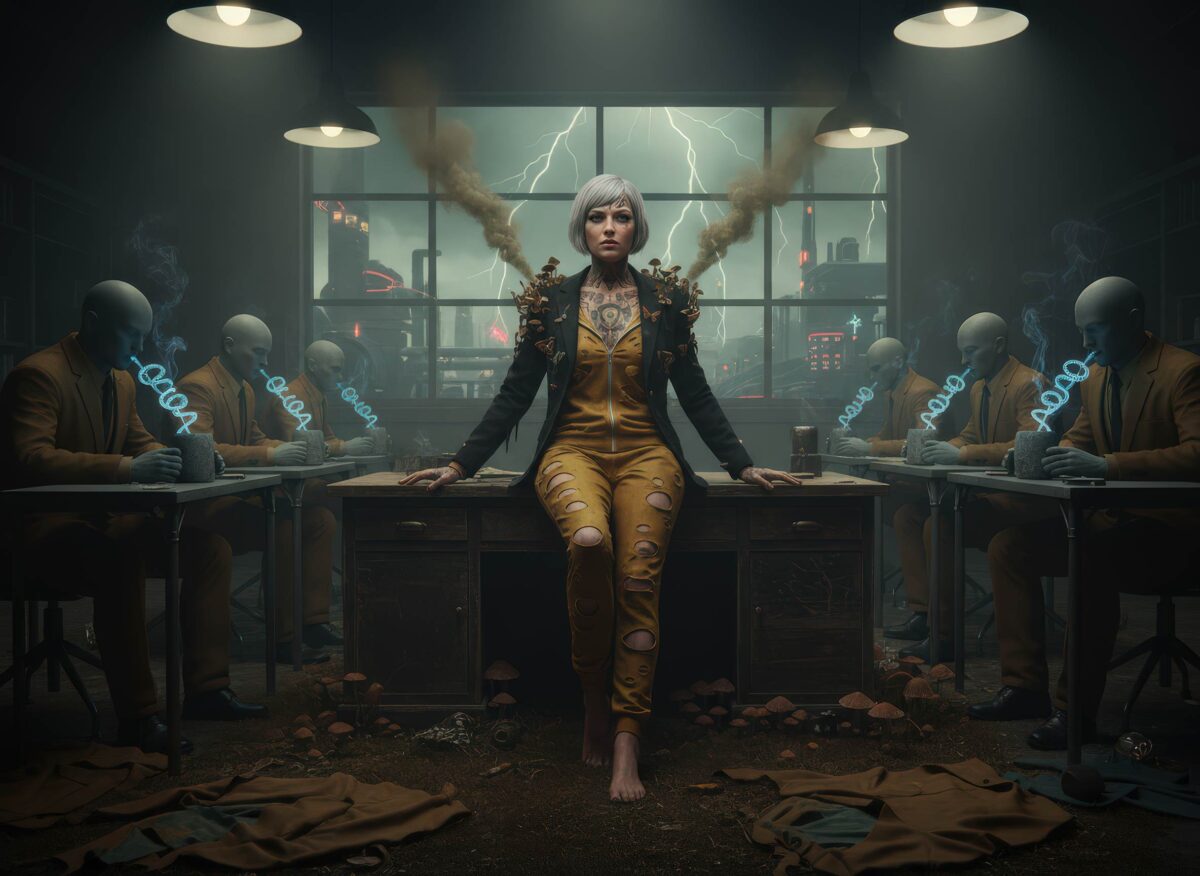
Despite excelling academically and in her career Alma has ended up ‘wearing’ an outer cloak of denial .
The Plane Is Going to Crash But first we get to see a close-up of a mountain

Russell Trotter Steedman
18:00 GMT Tuesday, 4 March 2026
T
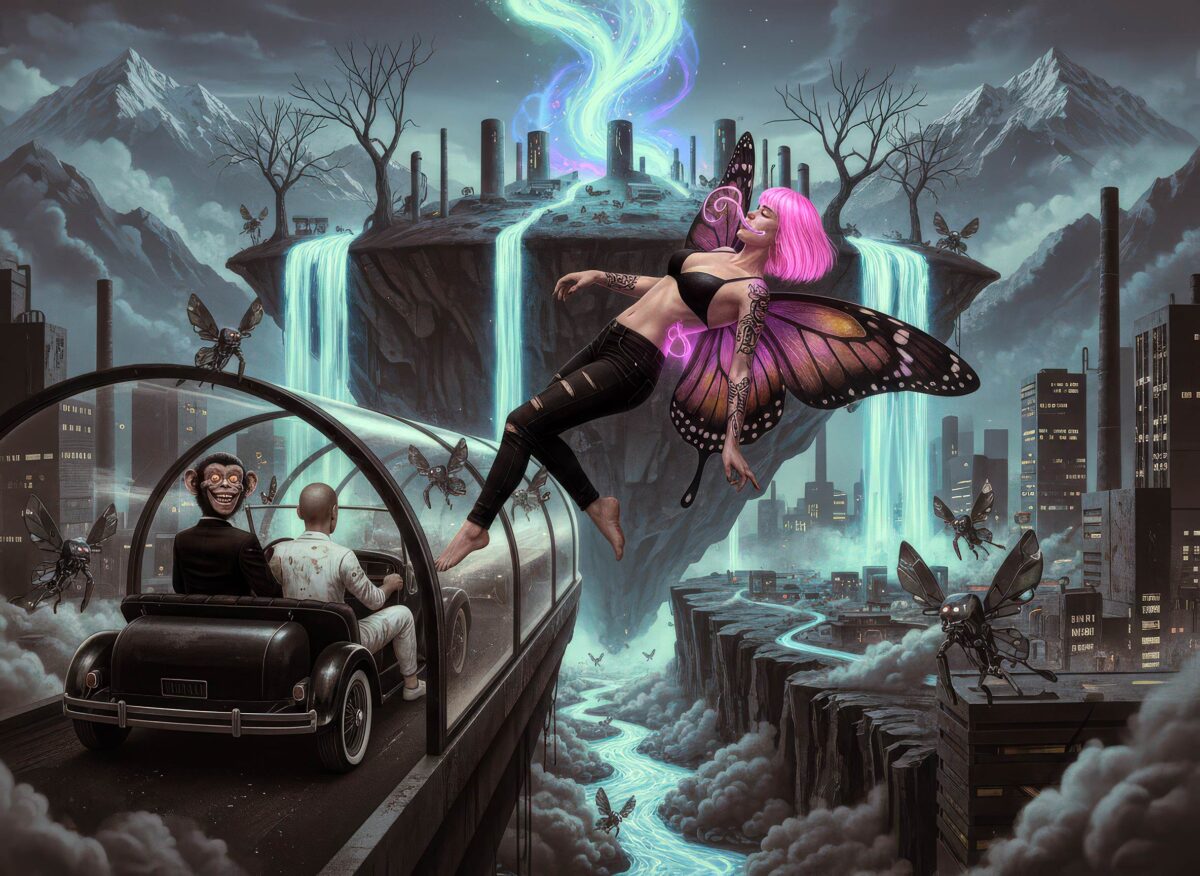
here are many forms of addiction. In The Plane Is Going to Crash But First We Get To See a Close-up of a Mountain, the fourth story in my book The Monkey In The Tunnel Alma is a commercial pilot who is close to being grounded by her employers, ‘The Kontrollers’ on psychological grounds.
In the story Alma is a highly talented engineer who has designed the actual ‘flying machines’ and is a top operator in The Fabrik Zone, the industrial beating heart of Wet City where the story takes place. She is a pilot mainly out of her own choice so she can test out her flying machines and enjoy an exciting lifestyle flying to New Sorsiden (Australia) and yet she is also very fragile and vulnerable due to denial aout her relationship status.
This denial has become a form of disassociation.
The back-story of Alma partly revolves around the implication that she has grown up in an environment with emotionally stunted and repressed parents and the influence this has had upon her.
Despite excelling academically and in her career Alma has ended up ‘wearing’ an outer cloak of denial and suppression as though her career and intellect is simply a way for her to cover-up her own deep-set personal sense of insecurity.
In the story she lives in New Sorsiden with Ellie The Alcoholic who is explicitly her girlfriend in the story itself from the reader’s point of view and yet, to Doctor Filippa the Head Kontroller in The Fabrik Zone itself this relationship is unknown as it is in the entire context of the story itself.
Whether in real the intricate details of any pilot’s romantic life are of relevance or interest or not to any type of ‘psychological assessors’ this is mainly discounted in the somewhat ‘heightened’ world of The Wetlands and, especially in The Fabrik Zone.
After all, the story is fiction and this very ‘choice’ - to explore the world of active addiction and try to decipher avenues for recovery - through a combination of lived experience and imagination as opposed to any actual medical know-how, is simply another method of attempting to ‘get to the bottom of things’ (which is a catchphrase of Doctor Filippa’s herself).
In the story Alma it becomes apparent that, on a couple of occasions when she has ‘felt truly alive’, Alma has a desire to be free and yet this seeming emotional freedom it itself is both confusing and elusive to her. She cant quite pinpoint exactly why she feels ‘dead inside’ permanently when outwardly she is so successful.
She is well-off materially, professionally respected and even has a beautiful lover who she was fortunate to pick up one day on the ‘Wet App’ (the Wet World’s own version of Tinder).
As the story progresses, without revealing the entire bones of the narrative, the experience of Alma’s denial to herself manifests as an impulsive and violent reaction to rejection and ultimately culminates as an epic ‘air incident involving hundreds of people’ which forms the core of the story in The Monkey In The Tunnel.
The title of the story itself, without giving too much away, is about the ‘moment’ between life and death, when we know death is imminent and certain and what we may choose to do with this ‘ultra-brief window of time’.
When we live we always live ‘in the moment’ whether we like it or not. The mantra itself of ‘live in the now’ is a fairly redundant notion when one thinks about it. How can we not?
However, since so much of active addiction is about anxiety and, particularly a ‘response to anxiety’ - basically an extremely short-term attempt to ‘dull the noise’ and cancel out the worst effects of reliving past trauma whilst mitigating a sense of re-experiencing the very same event again ‘in the moment’ - it makes sense to consider that the opposite of this ‘condition’ or perhaps ‘quagmire’ is to look our fear head-on and embrace it rather than to turn and run.
In the scenario in the story I was imagining the German Wings air disaster which was due to the mental health deterioration of the pilot and perhaps the same situation with the Malaysia Airlines flight which went off course and disappeared over the ocean a while back now, although this has never been proven.
In fact there are several, ‘many’ even, air disasters and other such events which speak to a desire within certain people to ‘take others out during a suicide event’.
Of course school massacres and such-like are also part and parcel of this tragic occurrence which, although it may have long been occurring in some capacity, seems to have become almost a daily, or at least weekly feature of our news cycles.
My interest as a writer is in what is underlying or, in the case of Alma The Pilot, what may be creating the ongoing trauma which leads to the suicidal and murderous impulse within come individuals.
In Alma’s case religious shame is one reason discussed in the story.
Later in Story 8: The Residue Of Shame in The Monkey In The Tunnel, the character Storm is a direct addressing of this very concept also and Storm features in this story also.
Although she is a white witch, Storm fears flying, or at least the advent of flying machines and ends up having an interaction with Alma when she wanders into cabin from the flight deck to get some perspective after becoming highly emotional charged.
Going back to the ‘vibes’ given out by Alma, Storm, as a ‘spiritual entity’ – the main spiritual character in the book – senses Alma’s inner turmoil and engages with her with compassion whilst also displaying her own fraught nerves about Alma’s capacity to manage the craft through the Wetsky.
The pair grasp each other’s rather extreme, anxious energy whilst also empathising and drawing inner angst outwards in the scene.
Sometimes, perhaps with addiction the addict them self simply believes that ‘being alive in the moment’ equates to living a fulfilled life, even if there is a strong sense of feeling the effects of the ‘consequences’ and accepting the danger inherent in self-destructive activities.
Layered upon ‘the cruel trick’ is the ‘normalisation’ of addiction in society. After all - if everyone else is doing it why can’t I?
For Alma the secretive experience of a gay relationship, whether the immediate and wider society is ‘nowadays’ accepting or not has become an actual compulsion in itself.
Her own natural impulse is to hide away her shame which contrasts with the story of Storm who is ‘outed’ for smelling of strange witch’s concoctions whilst ‘working in an office-land in Sor City’ (based on London) long ago.
Storm reacts by accepting, even embracing the labelling of herself by her colleagues whilst Alma rejects the questioning of Doctor Filippa who is concerned about Alma’s mental state and intent on grounding her.
In The Residue Of Shame story the character of Storm, like all the characters in the book experiences the downsides of her own life choices which, in her case, results in being shunned and rejected directly for her openness and, perhaps lack of consideration towards others.
In the case of Alma the direct opposite is true in many ways.
So, in the 10 Stories About Active Addiction – the subtitle of The Monkey In The Tunnel – Alma represents the voice of denial and suppression of one’s true, innermost desires and perhaps the masking of such knowledge about ourselves with substances, compulsive behaviour and disassociation with reality.

Russell Trotter Steedman
Latest posts by Russell Trotter Steedman (see all)
- The Monkey In The Next Tunnel - March 12, 2026
- The Broken Jigsaw - March 12, 2026
- The Residue Of Shame - March 12, 2026